
Issue #302 - The ML Engineer 🤖
State of Prod ML 2024 Survey, ML Optimization Gone Wrong, Google Dev Goals XKCD 10y Hard vs Impossible, GPU Puzzles + more 🚀
Thank you for being part of over 60,000+ ML professionals and enthusiasts who receive weekly articles & tutorials on Machine Learning & MLOps 🤖 You can join the newsletter for free at https://ethical.institute/mle.html ⭐
If you like the content please support the newsletter by sharing with your friends via ✉️ Email, 🐦 Twitter, 💼 Linkedin and 📕 Facebook!
If you are a Machine Learning Practitioner looking for an interesting opportunity, I'm currently hiring for an Applied Science Manager for Forecasting & Causal Inference for a Senior Applied Scientist for Forecasting - do check it out and do feel free to share broadly!
This week in Machine Learning:
State of Prod ML 2024 Survey
ML Optimization Gone Wrong
Google Measuring Dev Goals
XKCD 10y: Hard vs Impossible
GPU Puzzles For Fun & Profit
Open Source ML Frameworks
Awesome AI Guidelines to check out this week
+ more 🚀
34% of organisations take between 1-3 months to productionise a machine learning model, and over 20% take even longer up to 6 months - fantastic insights only a few weeks from launching the Prod ML 2024 Survey! We have designed the questions to provide meaningful insights on the current landscape of production ML in 2024 - if you have a chance we would be grateful if you could spend a few minutes on the survey, as you'll contribute valuable information about the machine learning tools and platforms you use in your production ML development. Your input will help create a comprehensive overview of common practices, tooling preferences, and challenges faced when deploying models to production, ultimately benefiting the entire ML community 🚀
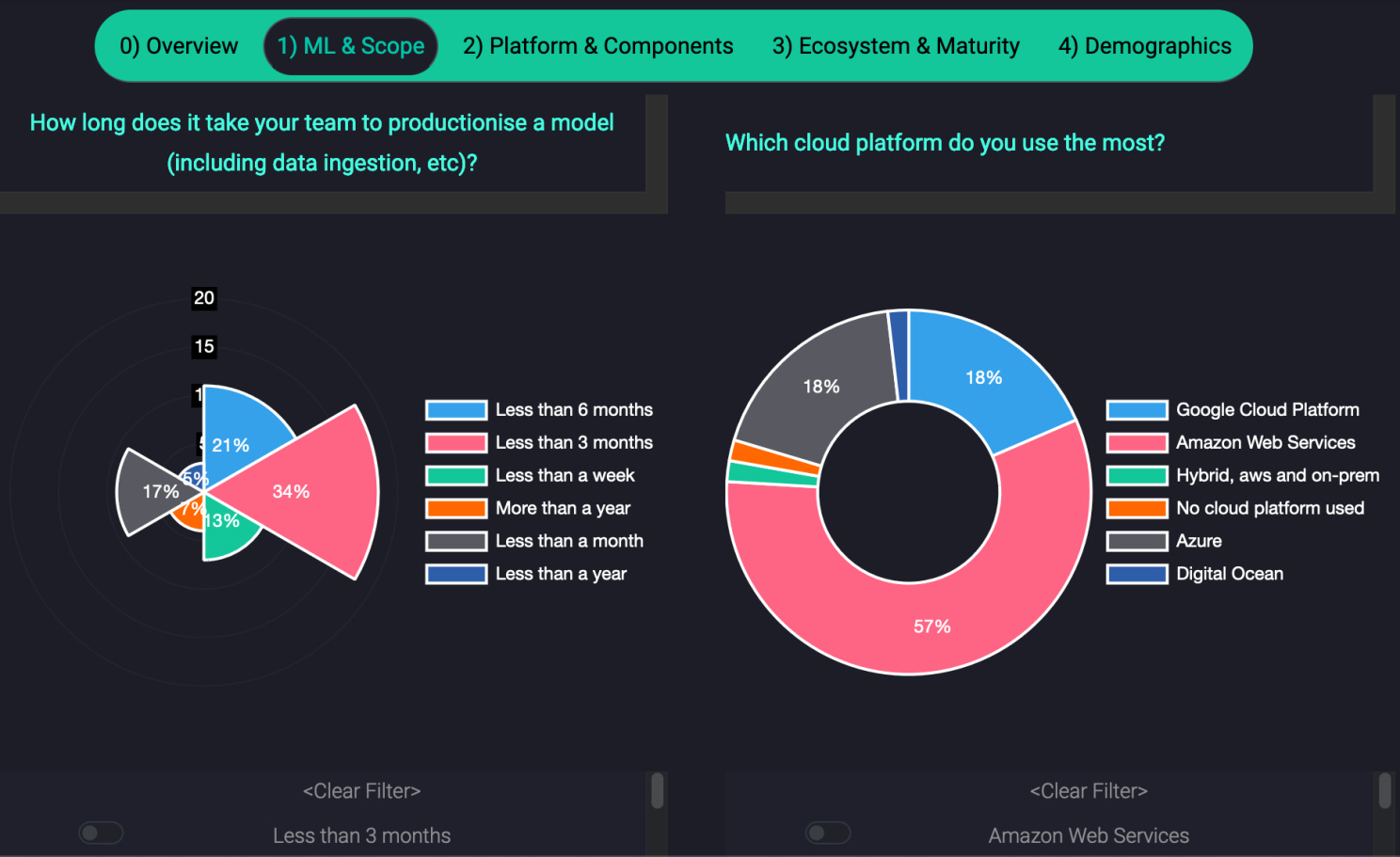
We are also working on an interactive visualisation for everyone to be able to slice and dice across the data to derive meaningful insights on the production ML ecosystem!
When a measure becomes a target, it ceases to be a good measure; Goodhart's law showcasing when too much optimization is deterimenal - great deep dive from Anthropic (+ former Google Brain) researcher. Increased efficiency can paradoxically worsen outcomes, which is a phenomenon termed by the strong version of Goodhart's Law, which is compared to the concept of overfitting in machine learning. Overfitting occurs when an ML model over-optimizes a specific dataset instead of the generalised distribution expected to be seen in the real world. It is possible to mitigate these isuses by better aligning proxy objectives with true goals, introducing regularization penalties, injecting noise, applying early stopping, and adjusting system capacities.
Google on Measuring Machine Learning Productivity Goals across organisations: A great paper from Google's Developer Productivity team on the importance of understanding and measuring overarching developer goals to enhance productivity and experience, especially in complex, iterative workflows common in production machine learning. Google developed a concise list of 30 durable and observable developer goals spanning the software development lifecycle by combining attitudinal data from surveys with behavioral data from usage logs.
Thrilled to celebrate 10 years of XKCD, which now for over a decade have brought humorous and insightful comics reflecting the challenges and ironies in computer science. Today they share an ironic and comical post on foundation ML models in the context of how difficult it is to distinguish "easy" tasks from "hard" tasks in software development, but indeed in this case in context of LLMs. Here is to many more years of insightful and inspiring XKCD comics!
This is the time to learn General-Processing GPU compute programming, and GPU-Puzzles are a fantastic way to get started: This new interactive notebook tutorial is a great intro to GPGPU designed for research & production machine learning practitioners to learn GPU programming fundamentals using Python's NUMBA, which compiles Python code into CUDA kernels. This resource is quite comprehensive as it teaches essential concepts like thread and block management, shared memory usage, and efficient computation of core deep learning algorithms such as pooling, convolution, and matrix multiplication (of course).
Upcoming MLOps Events
The MLOps ecosystem continues to grow at break-neck speeds, making it ever harder for us as practitioners to stay up to date with relevant developments. A fantsatic way to keep on-top of relevant resources is through the great community and events that the MLOps and Production ML ecosystem offers. This is the reason why we have started curating a list of upcoming events in the space, which are outlined below.
Upcoming conferences where we're speaking:
TUM AI@WORK 10th October @ Germany
Other upcoming MLOps conferences in 2024:
ODSC West - 29th October @ USA
Data & AI Summit - 10th June @ USA
AI Summit London - 12th June @ UK
World Summit AI - 9th October @ Neatherlands
MLOps World - 8th November @ USA
In case you missed our talks:
The State of AI in 2024 - WeAreDevelopers 2024
Responsible AI Workshop Keynote - NeurIPS 2021
Practical Guide to ML Explainability - PyCon London
ML Monitoring: Outliers, Drift, XAI - PyCon Keynote
Metadata for E2E MLOps - Kubecon NA 2022
ML Performance Evaluation at Scale - KubeCon Eur 2021
Industry Strength LLMs - PyData Global 2022
ML Security Workshop Keynote - NeurIPS 2022
Open Source MLOps Tools
Check out the fast-growing ecosystem of production ML tools & frameworks at the github repository which has reached over 10,000 ⭐ github stars. We are currently looking for more libraries to add - if you know of any that are not listed, please let us know or feel free to add a PR. Four featured libraries in the GPU acceleration space are outlined below.
Kompute - Blazing fast, lightweight and mobile phone-enabled GPU compute framework optimized for advanced data processing usecases.
CuPy - An implementation of NumPy-compatible multi-dimensional array on CUDA. CuPy consists of the core multi-dimensional array class, cupy.ndarray, and many functions on it.
Jax - Composable transformations of Python+NumPy programs: differentiate, vectorize, JIT to GPU/TPU, and more
CuDF - Built based on the Apache Arrow columnar memory format, cuDF is a GPU DataFrame library for loading, joining, aggregating, filtering, and otherwise manipulating data.
If you know of any open source and open community events that are not listed do give us a heads up so we can add them!
OSS: Policy & Guidelines
As AI systems become more prevalent in society, we face bigger and tougher societal challenges. We have seen a large number of resources that aim to takle these challenges in the form of AI Guidelines, Principles, Ethics Frameworks, etc, however there are so many resources it is hard to navigate. Because of this we started an Open Source initiative that aims to map the ecosystem to make it simpler to navigate. You can find multiple principles in the repo - some examples include the following:
MLSecOps Top 10 Vulnerabilities - This is an initiative that aims to further the field of machine learning security by identifying the top 10 most common vulnerabiliites in the machine learning lifecycle as well as best practices.
AI & Machine Learning 8 principles for Responsible ML - The Institute for Ethical AI & Machine Learning has put together 8 principles for responsible machine learning that are to be adopted by individuals and delivery teams designing, building and operating machine learning systems.
An Evaluation of Guidelines - The Ethics of Ethics; A research paper that analyses multiple Ethics principles.
ACM's Code of Ethics and Professional Conduct - This is the code of ethics that has been put together in 1992 by the Association for Computer Machinery and updated in 2018.
If you know of any guidelines that are not in the "Awesome AI Guidelines" list, please do give us a heads up or feel free to add a pull request!
About us
The Institute for Ethical AI & Machine Learning is a European research centre that carries out world-class research into responsible machine learning.