
Issue #332 - The ML Engineer 🤖
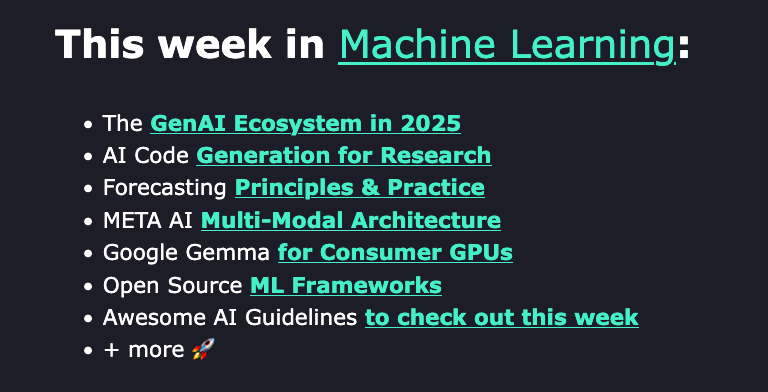
The GenAI Ecosystem in 2025, AI Code Generation for Research, Forecasting Principles & Practice, META AI Multi-Modal Architecture, Google Gemma for Consumer GPUs + more 🚀
Thank you for being part of over 70,000+ ML professionals and enthusiasts who receive weekly articles & tutorials on Machine Learning & MLOps 🤖 You can join the newsletter for free at https://ethical.institute/mle.html ⭐
If you like the content please support the newsletter by sharing with your friends via ✉️ Email, 🐦 Twitter, 💼 Linkedin and 📕 Facebook!
This week in Machine Learning:
AI Code Generation for Research
Forecasting Principles & Practice
META AI Multi-Modal Architecture
Google Gemma for Consumer GPUs
Open Source ML Frameworks
Awesome AI Guidelines to check out this week
+ more 🚀
If you're looking for an interesting career opportunity, I'm hiring for a few roles including Data Science Manager (Forecasting), as well as Data Scientist (Forecasting) - check them out and please do share with your network!
The growth of GenAI & ML has brought new emerging challenges; in this talk we dive into the state of production of GenAI & ML in the cloud native ecosystem, where we provide an overview of trends, challenges, opportunities and tooling that the ecosystem is standardizing towards. As part of this session, provide a snapshot of the current state of the ecosystem, as uncovered by recent surveys, which highlights the gaps in tooling and skills. We will then cover the best practices and tooling that are arising from production use-cases of LLMOps/MLOps at scale to tackle domain-specific challenges such as agentic-workflows, AI guardrails, efficiency requirements - between others. These include the OSS frameworks that are supporting the end-to-end LLMOps / MLOps lifecycle across pipelining, optimization, productionisation, monitoring/observability and ML safety. Check it out!
AI Code Generation for Research
Automatically generating code from a research paper sounds like fiction (and probably still is), but this is a really interesting initiative that takes a stab at building a specialised model: This Paper2Code framework automates generation of code from machine learning research papers through a multi-stage pipeline that includes planning, analysis, and coding phases. It is interesting to see the reasoning steps organising details of the paper and then assessing implementation needs to enable the generation. This also comes with some interesting benchmark datasets that can support further research on this space, and seems there are opportunities to improve as already outperforming other competing models such as ChatDev and MetaGPT.
Forecasting Principles & Practice
Forecasting is one of the most popular applications of machine learning in 2025, and building a career around it a great opportunity - this free online book from some of the top researchers in the field is the one resource to get started and/or take your knowledge to the next level. Forecasting: Principles & Practice (the Pythonic way) brings together hands-on reproducible Python code and real-world examples covering fundamental to advanced forecasting techniques such as ARIMA, exponential smoothing, neural networks, and transformer-based models. This is easily one of the best resources out there for anyone from professionals to students as it leverages some of the most popular OSS tools in forecasting like Nixtla, and has some practical exercises, datasets, and case studies to demonstrate concepts. This is definitely a resource worth investing some time to at the very least skim through.
META AI Multi-Modal Architecture
META AI releases a transformer architecture to rule them all, aiming to capture complex modalities in a single architecture including image, text, audio, depth, thermal, and IMU data: ImageBind is a multimodal AI architecture / model that creates a unified embedding space by aligning six sensory modalities without needing paired data for every possible combination, which can be widely applicable (particularly in robotics). It leverages images as a bridge and enables tasks such as cross-modal retrieval, audio-to-image generation, and zero-shot recognition across different modalities. It is interesting to see this approach more repeatedly across research and initiatives as this opens up new possibilities for multimodal applications across content creation, immersive virtual experiences, and multimodal search.
Google Gemma for Consumer GPUs
Google Deepmind keeps innovating with their Open Weights family of Gemma 3 QAT Models, now jumping into the efficiency wagon providing models that run more easily on consumer-grade GPUs: The new models are optimized with Quantization-Aware Training which drastically reduces memory requirements without hindering performance making models like Gemma 3 27B runnable on GPUs like the NVIDIA RTX 3090. For example, Gemma 3 27B's VRAM requirement drops from 54 GB to just 14.1 GB with int4 quantization, and also provides promising pathways to unlock further optimizations that can unlock execution in more hardware-limited devices such as mobile phones.
Upcoming MLOps Events
The MLOps ecosystem continues to grow at break-neck speeds, making it ever harder for us as practitioners to stay up to date with relevant developments. A fantsatic way to keep on-top of relevant resources is through the great community and events that the MLOps and Production ML ecosystem offers. This is the reason why we have started curating a list of upcoming events in the space, which are outlined below.
Upcoming conferences where we're speaking:
WeAreDevelopers 2025 - 9th July @ Berlin
SRE Con EMEA 2025 - 7th Oct @ Dublin
Other upcoming MLOps conferences in 2025:
ODSC East - May 13 @ Boston
Data & AI Summit - 9th June @ San Francisco
Data & AI Summit - 10th June @ USA
AI Summit London - 12th June @ UK
World Summit AI Europe - 08 Oct @ Amsterdam
MLOps World - Oct 8-9 @ Austin
In case you missed our talks:
Prod Generative AI in 2024 - KubeCon AI Day 2025
The State of AI in 2024 - WeAreDevelopers 2024
Responsible AI Workshop Keynote - NeurIPS 2021
Practical Guide to ML Explainability - PyCon London
ML Monitoring: Outliers, Drift, XAI - PyCon Keynote
Metadata for E2E MLOps - Kubecon NA 2022
ML Performance Evaluation at Scale - KubeCon Eur 2021
Industry Strength LLMs - PyData Global 2022
ML Security Workshop Keynote - NeurIPS 2022
Open Source MLOps Tools
Check out the fast-growing ecosystem of production ML tools & frameworks at the github repository which has reached over 10,000 ⭐ github stars. We are currently looking for more libraries to add - if you know of any that are not listed, please let us know or feel free to add a PR. Four featured libraries in the GPU acceleration space are outlined below.
Kompute - Blazing fast, lightweight and mobile phone-enabled GPU compute framework optimized for advanced data processing usecases.
CuPy - An implementation of NumPy-compatible multi-dimensional array on CUDA. CuPy consists of the core multi-dimensional array class, cupy.ndarray, and many functions on it.
Jax - Composable transformations of Python+NumPy programs: differentiate, vectorize, JIT to GPU/TPU, and more
CuDF - Built based on the Apache Arrow columnar memory format, cuDF is a GPU DataFrame library for loading, joining, aggregating, filtering, and otherwise manipulating data.
If you know of any open source and open community events that are not listed do give us a heads up so we can add them!
OSS: Policy & Guidelines
As AI systems become more prevalent in society, we face bigger and tougher societal challenges. We have seen a large number of resources that aim to takle these challenges in the form of AI Guidelines, Principles, Ethics Frameworks, etc, however there are so many resources it is hard to navigate. Because of this we started an Open Source initiative that aims to map the ecosystem to make it simpler to navigate. You can find multiple principles in the repo - some examples include the following:
MLSecOps Top 10 Vulnerabilities - This is an initiative that aims to further the field of machine learning security by identifying the top 10 most common vulnerabiliites in the machine learning lifecycle as well as best practices.
AI & Machine Learning 8 principles for Responsible ML - The Institute for Ethical AI & Machine Learning has put together 8 principles for responsible machine learning that are to be adopted by individuals and delivery teams designing, building and operating machine learning systems.
An Evaluation of Guidelines - The Ethics of Ethics; A research paper that analyses multiple Ethics principles.
ACM's Code of Ethics and Professional Conduct - This is the code of ethics that has been put together in 1992 by the Association for Computer Machinery and updated in 2018.
If you know of any guidelines that are not in the "Awesome AI Guidelines" list, please do give us a heads up or feel free to add a pull request!
About us
The Institute for Ethical AI & Machine Learning is a European research centre that carries out world-class research into responsible machine learning.